

Digital marketing world provides two immense marketing enterprises:
Pay-per-click marketing and search engine optimization.
Which do you prefer?
It is apparently known that PPC is better than SEO. But, many articles proved SEO marketing strategy more useful than PPC.
And, of course, there are different article that belongs to 100 different sites:
SEO vs. PPC: Which Is Best?
But here’s the truth:
Both can produce result-oriented business in different aspects and depending on the type of business you have, one can be considered better than the other.
And argument regarding these marketing tactics is useless.
In fact, the two can learn a lot of useful lessons from each other.
In this post, we are providing you five different tips that SEOs can learn from PPC managers and it’s execution in their strategy.
1.Data-informed strategies are always worthy
The success rate of data analyzation in PPC is far better than that of SEO.
PPC has a very clear goal: close the deal. unless you are running PPC campaigns for brand awareness, but that’s a different thing..
Besides traditional aspect, PPC plays a significant role in making sales.
At the other hand, SEO struggles in giving brand awareness to customers according to their interest.
Hence, there’s a less chance for data analysis, and understanding the process of your prospects in SEO as compared to PPC.
You have to analyze their on-site behavior, their response towards emails, their time on site, and how their interaction.
Whereas, PPC provides a quick response to remarketing campaign to bring them back.
Sadly, SEO do not encourage such easy campaign that can affect your sales.
In PPC, you directly know what you need to focus on: the bottom line.
Here is a case study from IntuitSolutions. This multi-year project with a client led to a PPC conversion rate increase of 60%.
How did they do it?
PPC makes data a priority. they didn’t follow new trends for producing content like SEOs can sometimes do.
In the first few stages of the campaign setup, they made data their focal point by using Google Analytics call reports and goal/event tracking:
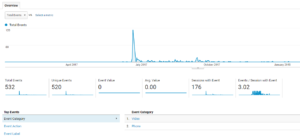
Next, they starting testing the waters with AdWords and seeing what the data said. For instance, how did traffic and conversions impact their bottom line? What could they do to decrease costs?
A big difference here between PPCs and SEOs is that SEO often focuses on bringing in more traffic. But what does your data tell you? Is your conversion rate low?
Maybe you don’t need more traffic. Perhaps you need to focus on increasing conversions from your existing traffic instead.
And that’s exactly what IntuitSolutions did. They decided to “Reduce wasted spend to drive better – not more – traffic.”
Doing so resulted in huge increases in everything from organic to direct traffic:
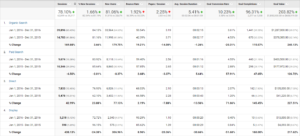
You may notice a minor drop in paid search traffic, but that’s exactly what they wanted.
PPC do not generate the most traffic for sales. It’s about converting as many as possible and letting the data tell you when to spend more.
They increased conversions by 60%, While decreasing their traffic by nearly 7%.
The data showed that low-quality scores were harming their conversion rates.
Subsequently, they improved them by creating better landing pages, forming better ad groups, and reducing wasted spend.
PPC s always focused on their bottom line .The data was the only reason they made changes.
Whereas SEOs get caught up in producing more traffic.
Instead, listen to the wisdom of PPC managers. They ask, “How can you increase conversions from existing traffic?”
Before running your next campaign, analyze your data to inform your next ten steps. Do you need to increase your conversion rates?
It is not about creating more content. You have to search for the ways to improve your current content or develop new lead magnets.
Although content is the soul of SEO, producing more without a data-based approach can’t do some wander.
2.Never go on autopilot. Always adjust and improve
Suppose you have started a new campaign. Things are going evenly, Leads are flowing in, and your content is driving a lot of association on social media.
So now, what will you do? You should now only relax, right?
Absolutely not.
When it comes to SEO and content marketing, you get satisfied.
You think that your current wave of leads, traffic, and engagement will drive the attention forever. You repeatedly follow same strategy.
You tell yourself, “Just keep blogging and producing more content.”
But truly,it is not as simple as that.
And PPC managers know this more than anyone.
Why do you think PPC managers run so many different ad groups?
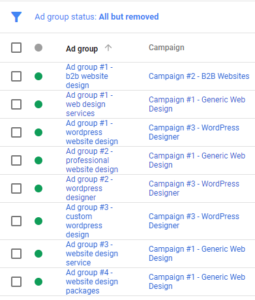
It’s because they’re always balancing. They are always moving, improving, and learning from every single campaign.
Their tactics never get unconsidered because they don’t repeat anything again and again.
They surely move on their big wins. But they don’t get self satisfied until there’s nothing left.
They simply keep digging for more strategies and new tactics to pursue.
A prime example of this is when PPC managers utilize the search terms report on Google AdWords.
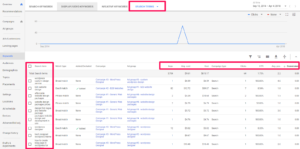
Believe it or not, on AdWords, you aren’t paying for specific keywords.
For example, the latest keyword that you research and bid on isn’t exactly what you’re buying with each click.
You could be bidding on this:
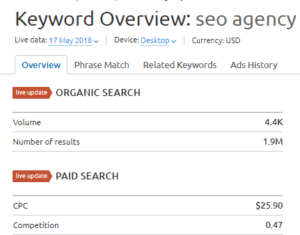
But in reality, you’re paying for these:

These are search terms. They’re related, real keyword searches that differ by match types.
Just bidding on “SEO agency” doesn’t mean you only show up for “SEO agency.”
SEOs can learn a lot from PPC managers. Good PPC managers find the low-hanging fruit and avoid repeatation.
They never get comfortable, they always try to discover more ideas for more campaigns.
By looking at the search terms report, they analyze easy wins by finding searches they are showing up for and creating entirely new campaigns around them.

They move deep into each one to create individual landing pages and experiences.
Here’s the key takeaway: Always look for new, fresh ideas in your SEO strategy.
Don’t just be sitted and relax. You should look for new ideas on the basis of customer’s interest. Always look for new mediums to test.
You can do just that by using a tool like Google Trends or BuzzSumo.
If you’re only blogging, research different formats like video, podcasts, or slideshows.
Inspite of repeating the same task, Look for new ways to create engaging campaigns.
3.Learn the art of writing compelling and click-worthy metadata
If you’ve ever used Google AdWords or written a text-based PPC ad before, you know the struggle.
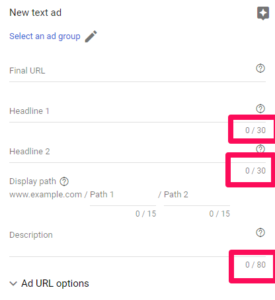
Overloading all your important, value-driven data into a limited character space is simply tough.
You get 30 characters for the first headline, 30 more for the second, and only 80 for your description.
That’s a grand total of 140 characters, which used to be the limit for a single tweet on Twitter:

How difficult that was. 140 characters are never enough to convey real value that brings customers to take action.
Writing meta descriptions and titles is just like writing new ads on AdWords:
You only aim at providing more value to the searcher to improve your CTR and further your rankings.
Here is what SEOs can learn from PPC managers who write multiple ads per ad group and keep writing new ones on a daily basis.
They know what formulas, strategies, and quick value lines work to produce better click-through rates on non-branded searches.
Here is an example of simple strategies from PPC expert Johnathan Dane of KlientBoost. He grew his PPC agency from $0 in revenue to over $1 million in just 12 months:
He achieved a great success with this easy-to-follow strategy with clients. By following a structure, you consistently repeat the keywords for customers to make them sure that they’re finding what they searched for.
Adding benefits and a CTA helps push them over the edge to click on your ad over the competition.
It is easy to duplicate every single new page you publish, but it’s hard enough to drive interest with specificity and keywords.
When writing your next meta title and description to accompany your latest content marketing piece, follow this simple yet effective strategy for improving your organic CTR:
Focus on the basics: talk directly to what the user is searching for. Make them assure that they are getting exactly what they are looking for.
In the example above, notice that the focus keyword of the post immediately appears in the title, description, and URL string.
Next, it describes the benefits for the searcher to see:
PPC ads give you wonderful ideas for your meta description.
Simply Google a keyword that your page or latest blog post covers.
For example, I was recently writing a post about content marketing tips in 2018. But I found it very difficult to make a convincing meta title and description.
So I switched to Google and typed in my long-tail keyword to get some ideas:
And immediately one specific AdWords ad came to my mind with a new idea:
This ad flips made a drastic change in driving massive appeal from a traditional combination of listed formats.
Reasons why it’s not working.
It’s just different from the other and gives you a better approach towards writing your post and meta description.
Instead of endorsing XX tips, you can recommend XX reasons why it’s not working and how to implement them in your 2018 content marketing strategy.
PPC ad writers have a exceptionable art of achieving a lot of interest in very few characters.
So if you have to write a meta and title, follow the formula from Johnathan or make a few Google searches to find innovative ideas.
4.Dedicated landing pages drive more conversions
As a diverse marketer, I use both SEO and PPC to my advantage.
I always focus on testing and creating new ideas with PPC. Even when I am not using PPC ads, I am investigating from different source.
Dedicated landing pages in PPC is much better than any other marketing strategy.
In fact, New Balance Shoes was able to increase sales by 200% while implementing dedicated landing pages.
It’s something that is seen very rarely in most SEO and content marketing campaigns I’ve worked on.
Generally people simply directs on blog post and moved into a form on the blog post in the form of a CTA. Later, they feel culpable of it.
Most of the people try to move around organic traffic into subscribers with a few simple calls to action.
But it works a few time, it can be much better.
And so is the reason why dedicated landing pages come into existence.
They become essential when using PPC for traffic and leads because they help to create specificity and a great user experience, leading to better quality scores.
Landing page experience is a huge piece of the quality score:
You can see this common tactic used by testing a simple search on your own.
For example, I was searching for social marketing tools, I clicked on one of the first ads from Falcon.io, a landing page appeared that was surely created for this compaign.
This dedicated landing page even highlights the keyword exactly which I was looking for.
And here is specificity. And specificity is king.
You should conduct your next content marketing campaign for organic traffic with dedicated landing pages to drive traffics with your calls to action.
For example, if you want people to sign up for a webinar, don’t ask them to fill a form.
You should provide a personalized, specific landing pages made for the purpose of webinar signups:
Always try to create better experiences for your new organic traffic that will keep them in touch with you.
Simply driving homepage traffic doesn’t work, even in SEO.
Every keyword search is different and packs different forms of intent. Ensure that your landing pages complete those needs each time and never settle for generic pages.
It also helps in segment landing pages by keyword intent. Depending on each stage of the funnel that a searcher is in, the landing page can be totally different while discussing the same product:
Top-of-the-funnel or new traffic that hasn’t visited your site before will not change on a high-risk item yet.
They are more likely to sign up for your webinar rather than buying any product or service.
So you can customize your landing pages to that specific intent.
If your content prefers buying any products or services, and is lower in the channel, your CTA landing pages should move towards a final sale or speak directly to a closing sales rep.
Here is an important thing SEOs can learn from PPCs for landing pages: specificity. Create dedicated pages and watch your conversions up in the sky.